PROTECT THE PEOPLE BEHIND THE PAYCHECK
Insurance and Family Protection for Federal Employees

Federal benefits can make life insurance easy to carry, but automatic coverage is not the same as complete protection. The right amount depends on the people who rely on your income, the debts and expenses they would inherit, and the benefits that would continue after your death.
This page will help you take inventory, define the job your coverage needs to do and compare your choices without treating FEGLI, WAEPA or private term insurance as automatic winners.
Start with the protection question your household needs answered.
Begin with an inventory, not a product
List the coverage you already have through FEGLI Basic and any Options, an association plan, a private policy or a spouse’s employer. Record the benefit amount, beneficiary, current premium, expected future cost and whether the coverage depends on employment or continued eligibility.
This simple inventory often reveals the real issue. Some households have overlapping policies they no longer need. Others have assumed a salary-based benefit is enough even though the mortgage, income-replacement need and dependent care costs are much larger.
Define the job the insurance must do
Life insurance is a source of money at a difficult moment. Decide what that money should accomplish: replace income while a spouse adjusts, eliminate debts, fund childcare or education, cover final expenses, create liquidity or protect the household from selling investments or a home under pressure.
The need may be large when children are young and debts are high, then decline as savings grow and obligations disappear. That is why the right answer is rarely a fixed multiple of salary for an entire career. Use your household priorities to estimate the gap, then compare coverage designed to fill it.
PLANNING PRINCIPLE
The product decision follows the protection decision. You cannot know whether FEGLI, WAEPA or another policy is enough until you know what the benefit must accomplish.
Compare coverage over time—not just this paycheck
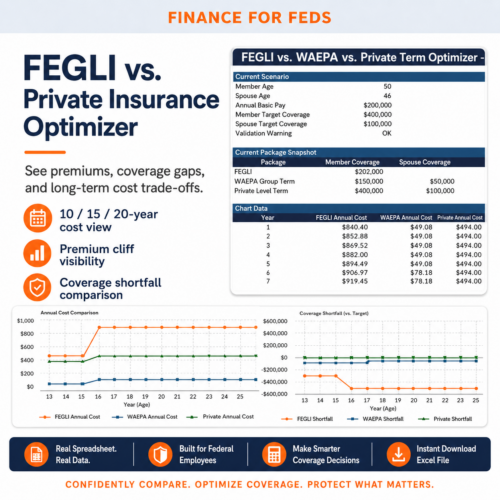
FEGLI is familiar, integrated with payroll and may be valuable when access or simplicity matters. Alternative or supplemental coverage may offer different benefit amounts or long-term costs, but it can involve eligibility requirements and underwriting. Neither structure is automatically better.
Project the premiums across the years you expect to keep the coverage. Review how benefit amounts may change with age or retirement. Then compare those costs with the flexibility, guarantees and application requirements of the alternatives. A policy that appears inexpensive today may look different in a later age band, while a lower quote is not useful if the coverage is never approved.
Avoid an accidental coverage gap
Do not cancel or reduce existing coverage because you received a quote or submitted an application. Wait until replacement coverage is approved, active and understood. Confirm the effective date, exclusions, premium structure, beneficiary and the conditions under which coverage can continue.
This is especially important when health has changed or retirement is approaching. An existing federal benefit may be difficult or impossible to recreate after it is dropped. Changes should follow confirmation—not optimism.
Include survivor benefits in the family-protection plan
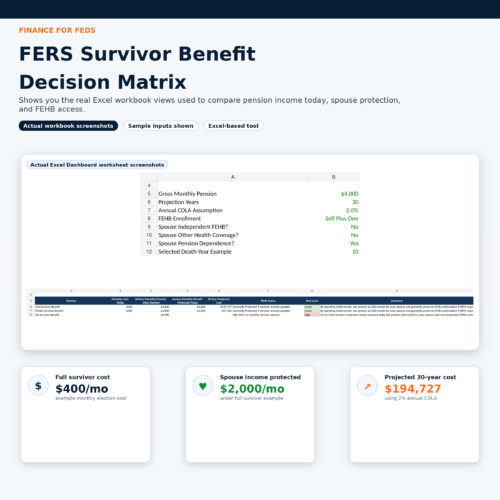
Life insurance is only one source of survivor protection. A FERS survivor annuity election can affect your monthly pension, the income available to a surviving spouse and, in many cases, how FEHB continuation fits into the plan. Beneficiary designations across FEGLI, TSP and other accounts also need to reflect current intentions.
Review the household as a system. Ask what income continues, which expenses remain, what healthcare costs may change and how much immediately available cash the survivor would have. A spouse should understand the tradeoffs before a permanent election is made.
Review protection when life changes
Insurance decisions should be revisited after marriage, divorce, a birth or adoption, a major mortgage change, promotion, health change, retirement planning milestone or the loss of other household coverage. Also review beneficiary forms periodically. A thoughtful coverage amount can still fail if the benefit is directed to the wrong person or an outdated plan.
Make the tradeoffs visible before you change coverage.
Use a focused workbook to compare cost and family protection with your own assumptions. The tools are educational estimates, not insurance recommendations or benefit determinations.
PROTECTION SHOULD BE PERSONAL—NOT AUTOMATIC
Know what your family would have before changing what you have.
Take inventory, define the protection gap and compare the long-term tradeoffs. When a federal benefit rule or policy detail could change the outcome, confirm it with the official source or coverage provider before making an election.
Federal insurance and survivor benefit decisions can have long-lasting consequences for both your budget and your family’s financial security. From comparing FEGLI costs against private term coverage to understanding how survivor benefit elections affect a spouse’s income and FEHB access, these tools help turn complicated benefit choices into clearer side-by-side comparisons. Use them to evaluate your coverage, identify potential gaps, and better understand the tradeoffs before making important protection decisions.