MONEY SYSTEMS THAT WORK WITH A FEDERAL PAYCHECK
Financial Basics for Federal Employees

Your federal paycheck may be predictable on paper, but the amount you can actually use is shaped by deductions most personal-finance advice barely mentions. FERS, TSP, FEHB, FEGLI, taxes, locality pay and step increases all move through the same check.
When you understand how those pieces fit together, budgeting stops feeling like restriction and starts working like a plan. This page will help you focus on the fundamentals that make every later decision easier: understand your take-home pay, give it a job, build a cash cushion and make intentional choices about taxes and retirement saving.
START WITH THE DECISION IN FRONT OF YOU
A stronger financial foundation starts with one clear next step.
Start with the money that reaches your bank account
A federal salary is only the top line. Before the rest reaches you, your paycheck may fund FERS, TSP contributions, health and life insurance premiums, federal and state taxes, and other elections. Those deductions are not all the same: some protect you today, some build benefits for later, and some simply need to be accurate.
That is why a useful federal budget starts with net pay. Review a recent earnings and leave statement, identify the deductions you can influence, and separate them from the deductions that are fixed. You do not need to optimize every line at once. You need to know where your money is going before deciding what should change.
Build a budget sturdy enough for real life
A workable budget should survive a normal month, not just look good in a spreadsheet. Start with essential commitments such as housing, utilities, transportation, insurance and minimum debt payments. Then account for flexible spending and the goals that matter to you—emergency savings, travel, home repairs, education or a future move.
The goal is not to force every household into the same percentages. It is to create a repeatable plan for each pay period. When step increases, promotions or locality changes raise your pay, decide in advance how much will improve life today and how much will strengthen savings, debt payoff or TSP contributions.
PRACTICAL CHECKPOINT
If your budget only works when nothing goes wrong, the problem may not be discipline. It may be that irregular expenses and future obligations have not been given a place in the plan.
Cash reserves create room to make better decisions
Federal employment can be stable without being interruption-proof. A shutdown, delayed reimbursement, household repair, medical expense or family emergency can still create a sudden cash need. An emergency fund gives you time to respond without using a credit card, taking a TSP loan or selling investments at the wrong moment.
Choose a reserve target that reflects your essential expenses, household income sources and real risks. A single-income family, a household approaching retirement or someone expecting a major transition may want more breathing room than a dual-income household with low fixed costs. Build the first useful layer, then increase it over time.
Debt and savings compete for the same paycheck
Paying down debt and saving for the future are both worthwhile, which is why the choice can feel frustrating. Begin by protecting the basics: stay current on required payments, keep a starter cash reserve and capture any TSP match available to you. Then direct additional dollars toward the obligation or goal with the greatest cost, risk or emotional pressure.
The right sequence will differ by household. What matters is that your plan reduces the chance of paying off debt only to borrow again when the next irregular expense arrives.
Connect taxes and TSP contributions to the rest of the plan
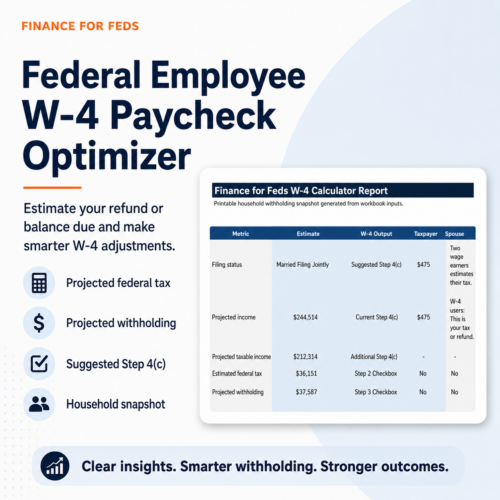
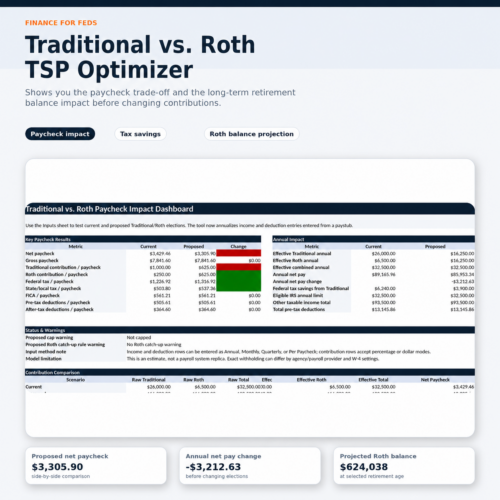
Tax withholding and TSP elections are not isolated decisions. They affect take-home pay now, taxable income, retirement savings and the flexibility available elsewhere in the budget. Traditional and Roth contributions can create different paycheck and future-tax tradeoffs; neither choice is automatically right for every federal employee.
Review withholding after a major pay change, marriage, divorce, second job or other household income shift. Revisit TSP contributions when your budget improves. Small, intentional adjustments are usually more sustainable than a dramatic change that has to be reversed a month later.
Turn good intentions into a working money system.
Use the tools that match the decision you are making now. Each workbook is designed to organize your assumptions, show the tradeoffs and give you a practical next step.
BUILD THE FOUNDATION ONCE. USE IT FOR EVERY DECISION.
Clear money basics make federal benefits easier to use.
You do not have to solve your entire financial life today. Start with the part of your paycheck or budget creating the most uncertainty, take one practical action and build from there.
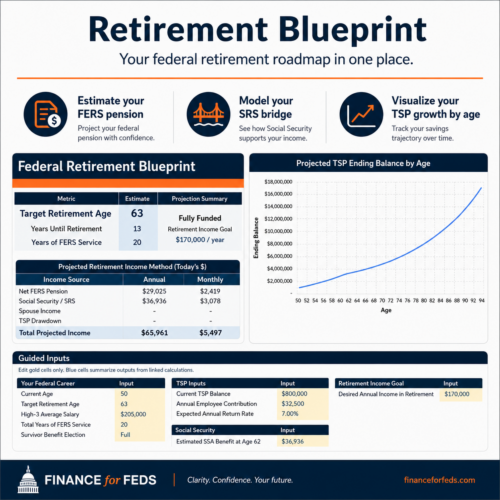
Strong financial planning starts with understanding your paycheck, taxes, spending, and savings decisions. These financial basics tools are built to help federal employees make sense of everyday money choices, including W-4 withholding, Traditional vs. Roth TSP contributions, current expenses, payroll deductions, and retirement budget planning. Use them to get organized, spot opportunities, and build a stronger foundation before moving into more advanced retirement and insurance planning.