
How to Budget on a GS Salary (Without Overcomplicating It)

How to Budget on a GS Salary (Without Overcomplicating It)

Published On: May 4, 2026By Tags: , , ,

Budgeting does not need to feel like a second job. That is especially true for federal employees.

If you are paid on the General Schedule, you already have one of the most useful budgeting advantages available: structure. Your pay is tied to a grade, step, locality area, and pay table. You usually know when your paycheck is coming. You can often see future step increases coming. You may have predictable benefits deductions, regular TSP contributions, and a fairly stable career path.

That does not mean budgeting is automatic. It just means federal employees can build a simpler system than many people realize.

The goal is not to track every coffee, build a 27-tab spreadsheet, or feel guilty every time you spend money. The goal is to understand your real take-home pay, give every major dollar a job, automate the important decisions, and use your GS career structure to your advantage. A good budget should make your financial life calmer, not more complicated.

Start With Net Pay, Not Your GS Salary

The first budgeting mistake many federal employees make is starting with their published salary. Your GS salary is not your spending money. A $100,000 salary does not mean you have $100,000 available to spend. Before money reaches your checking account, several things may already come out of your paycheck: federal income tax, state tax, Social Security and Medicare taxes, FERS contributions, TSP contributions, FEHB premiums, FEGLI premiums if enrolled, dental or vision coverage, FSA or HSA contributions, and other payroll deductions.

That is why budgeting should begin with your actual net pay. The General Schedule itself is structured, with 15 grades and 10 steps within each grade. OPM also notes that GS employees may receive within-grade step increases based on performance and longevity, and that most GS employees receive locality pay based on geographic area. That structure is useful. But your budget lives on the number that hits your bank account.

Imagine Sarah, a federal employee earning $100,000 per year. On paper, that sounds like about $3,846 every two weeks before deductions. But after taxes, TSP contributions, FEHB, FEGLI, and other deductions, assume her actual net paycheck is closer to $2,850. That is the number her monthly life has to fit inside.

Since federal employees are commonly paid biweekly, Sarah’s $2,850 paycheck equals about $74,100 per year in take-home pay, or roughly $6,175 per month on average.

That monthly number is where the budget begins. Not the salary table. Not the gross pay. The deposit.

Use a Simple Framework

Once Sarah knows her real take-home pay, she does not need to make budgeting complicated.

A simple starting point is the 50/30/20 framework:

50% for needs
30% for wants
20% for savings, debt payoff, and future goals

This framework is not perfect, and it should not be treated like a law. But it gives federal employees a quick way to see whether their spending is roughly aligned with their income.

Using Sarah’s estimated $6,175 monthly take-home pay, the framework would look like this:

Needs: about $3,088 per month
Wants: about $1,853 per month
Savings and financial goals: about $1,235 per month

Needs include housing, utilities, groceries, insurance, transportation, minimum debt payments, and other expenses that keep the household running.

Wants include restaurants, travel, subscriptions, hobbies, entertainment, upgraded technology, and other lifestyle spending.

Savings and financial goals include emergency fund contributions, extra debt payments, Roth IRA contributions, brokerage investments, sinking funds, and TSP contributions if you are counting them as part of your savings rate.

That last point matters. Many federal employees forget that TSP contributions may already be coming out of their paycheck before money reaches the checking account. If Sarah contributes 5% to the TSP, she is already saving for retirement automatically. The TSP also provides agency/service automatic and matching contributions for eligible FERS participants, with the agency/service contributing a total of 5% when the employee contributes 5% of basic pay.

So Sarah should not ignore her TSP when reviewing her savings rate. But she also should not assume TSP alone solves every financial goal.

TSP is for retirement.

An emergency fund is for stability.

A brokerage account may be for flexibility.

A sinking fund may be for a car, home repairs, travel, or a future move.

The budget should recognize all of those jobs.

Do Not Force the 50/30/20 Rule If Your Life Does Not Fit

The 50/30/20 framework is a guide, not a verdict.

A GS employee in a high-cost locality may not be able to keep needs under 50%. Housing alone can consume a large share of take-home pay in areas like Washington, D.C., New York, San Francisco, Boston, or parts of California. A single employee with no dependents may have more room for savings. A married employee with children, childcare costs, student loans, and a mortgage may need a more flexible framework.

The point is not to make everyone fit the same template. The point is to notice the tradeoffs.

If your needs are 65% of take-home pay, your wants and savings cannot also be large unless income rises. If your wants are creeping higher every year, your emergency fund, TSP, or debt payoff may be quietly falling behind. If your savings rate is strong but you are constantly stressed because your checking account is too tight, you may need more short-term cash flow before increasing long-term investments.

The budget is not there to shame you. It is there to show you what is happening.

Automate the Important Decisions

This is where federal employees have a real advantage. A lot of the most important financial decisions can be automated.

TSP contributions can come directly from payroll. Savings transfers can move automatically after each paycheck. Bills can be scheduled. Debt payments can be set up in advance. Separate accounts can be used for emergency savings, annual expenses, travel, or home repairs.

Automation matters because willpower is unreliable. Most people do not fail financially because they cannot do math. They fail because every paycheck becomes a fresh negotiation.

Should I save this time?

Should I pay extra on the debt?

Should I increase TSP?

Should I hold the money just in case?

Should I wait until next month?

Automation reduces the number of decisions.

For Sarah, a simple system might look like this: her TSP contribution comes out of payroll automatically, $300 per paycheck goes to a high-yield savings account, her mortgage and utilities are scheduled, and a separate checking account holds spending money for groceries, gas, restaurants, and household expenses.

She does not need to manually rebuild her budget every two weeks, because the system does most of the work.

Use Step Increases the Right Way

One of the most powerful budgeting opportunities for GS employees is the step increase.

OPM explains that each GS grade has 10 step rates and that within-grade increases are generally tied to acceptable performance and waiting periods. Steps 1 through 3 typically have one-year waiting periods, steps 4 through 6 have two-year waiting periods, and steps 7 through 9 have three-year waiting periods. That creates planning opportunities.

A step increase may not make you wealthy overnight, but it can improve your financial life if you do not immediately absorb it into lifestyle spending. This is where many federal employees quietly lose ground. They get a step increase, promotion, locality adjustment, or annual pay raise, and the money disappears. A better apartment. A nicer car. More restaurants. A larger vacation. More subscriptions. More convenience spending.

None of those things are automatically bad. The problem is when every raise becomes permanent lifestyle inflation.

A better approach is to decide in advance what will happen when pay increases.

For example, Sarah might decide that every time she receives a step increase, half of the increase goes toward better lifestyle and half goes toward her financial goals. If her paycheck rises by $160 every two weeks, she might keep $80 and redirect $80 to savings, TSP, Roth IRA, or debt payoff. That way, she still feels progress today while strengthening her future.

This is one of the easiest financial wins for federal employees because the timing is often more predictable than in many private-sector jobs.

Build the Budget Around Paychecks

Monthly budgeting can be awkward for biweekly employees because two months each year typically have three paychecks. A simple approach is to build your normal monthly life around two paychecks per month and treat the two “extra” paychecks as planning tools. Those third paychecks can be used for things like:

  • Emergency fund contributions
  • Car insurance or property taxes
  • Home repairs
  • Holiday spending
  • Travel
  • Extra debt payments
  • Roth IRA contributions
  • Brokerage investing
  • Large annual bills

This keeps the regular budget simple.

Sarah might use two paychecks each month to cover her normal expenses. Then, when a three-paycheck month arrives, she already knows the assignment: half to emergency savings and half to a travel or home-repair fund.

No guilt. No confusion. No wondering where the money went.

Separate Fixed Expenses From Flexible Spending

Another way to simplify budgeting is to separate fixed expenses from flexible spending.

Fixed expenses are bills that are relatively predictable: mortgage or rent, utilities, insurance, loan payments, subscriptions, childcare, and minimum debt payments.

Flexible spending is the category that tends to leak: groceries, restaurants, Amazon purchases, convenience stops, entertainment, hobbies, gifts, and miscellaneous household spending.

Many people try to track everything equally, but most budget problems happen in flexible categories. A federal employee does not necessarily need to categorize every transaction perfectly. Often, it is enough to know three numbers:

  1. What comes in each paycheck
  2. What fixed expenses must be paid
  3. What is left for flexible spending and goals

If your net paycheck is $2,850 and your fixed obligations consume $2,000 of it, you know the remaining $850 has to cover flexible spending, savings transfers, and anything else before the next paycheck. That is the number that matters.

Budgeting Is Not About Cutting Everything

A good GS salary budget should not be built around deprivation. It should be built around priorities.

There is nothing wrong with spending money on travel, restaurants, hobbies, family, home upgrades, or convenience if those expenses fit inside the larger plan. The problem is unconscious spending.

A federal employee who intentionally contributes to TSP, keeps an emergency fund, avoids high-interest debt, and plans for major expenses can enjoy spending without turning every purchase into a crisis.

The point of budgeting is not to remove enjoyment. The point is to make sure enjoyment does not quietly crowd out security.

The Common Mistake: Spending Every Raise

The most common GS budgeting mistake is not usually one dramatic bad decision. It is spending every raise as soon as it arrives.

A step increase gets absorbed. A promotion gets absorbed. A locality increase gets absorbed. A tax refund gets absorbed. A three-paycheck month gets absorbed. Over a 20- or 30-year federal career, that pattern can make a major difference. The employee may earn more every few years but never feel more financially secure.

The solution is simple but powerful: capture part of every increase.

Increase TSP by 1% after a raise. Send part of a step increase to savings. Use a third paycheck to eliminate a debt. Direct part of a promotion increase into a Roth IRA or brokerage account. The employee who does this consistently may not feel a huge change in any single paycheck, but the long-term result can be significant.

A Simple GS Budgeting System

For most federal employees, a workable budget can be built in five steps.

  1. Identify your actual net pay. Use your LES or payroll system, not your gross salary.
  2. List your essential monthly expenses. Focus on housing, utilities, food, transportation, insurance, debt payments, and required household costs.
  3. Pick a simple framework. The 50/30/20 rule is a good starting point, but adjust it for your cost of living, family situation, debt, and goals.
  4. Automate the important decisions. TSP, emergency savings, bills, and debt payments should happen before the money has a chance to disappear.
  5. Create a raise plan. Decide now what you will do with step increases, promotions, annual raises, and three-paycheck months.

That is enough. You do not need a perfect budget. You need a budget you will actually use.

Bottom Line

Budgeting on a GS salary does not have to be complicated. Federal employees have a built-in advantage: structured pay, predictable paychecks, strong benefits, and the ability to automate many of the most important financial decisions. But those advantages only help if you use them.

Start with your real take-home pay. Keep your framework simple. Automate savings and bills. Treat step increases as opportunities instead of excuses to spend more. Use your stable income to make calm, deliberate decisions.

A good budget is not about restriction. It is about control.

And for federal employees, that control can turn a steady GS paycheck into long-term financial progress.

Related Tools

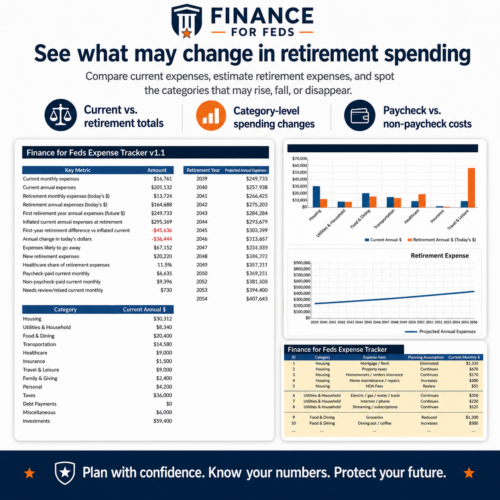
  • Financial success starts with understanding your spending. This planner tracks current monthly expenses, identifies payroll deductions, compares expected retirement expenses, and highlights which costs will disappear after leaving federal service.
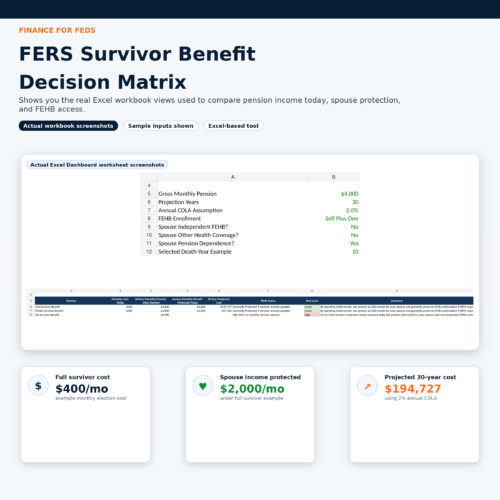
  • This decision matrix compares the maximum survivor benefit, partial survivor benefit, and no survivor benefit options in plain dollars. Users can see the monthly pension reduction, projected long-term cost, survivor income protection, and FEHB implications of each election.
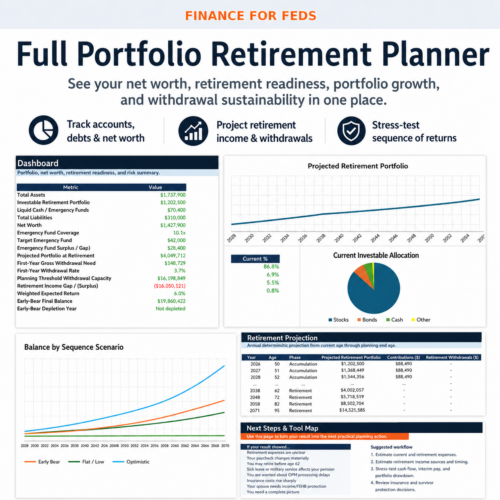
  • The Full Portfolio Retirement Planner helps federal employees look beyond a single account and understand how all of their assets work together. This workbook allows users to model TSP balances, IRAs, Roth IRAs, brokerage accounts, HSAs, cash reserves, pensions, Social Security, spouse income, liabilities, and retirement withdrawals in one coordinated projection.
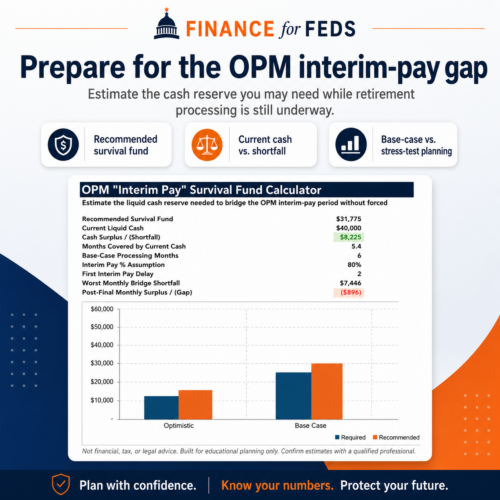
  • During OPM processing, retirees may receive only partial interim payments for several months while their final annuity is calculated. This calculator helps users estimate their potential income gap during that transition period by comparing projected interim pay against real retirement expenses.
newsletter sign-up

Sign up for our newsletter!

Get the latest from Finance For Feds straight to your inbox.

Go to Top