
How Much Emergency Fund Do Federal Employees Really Need?
When you work for the federal government, standard financial advice can feel out of touch. Traditional financial planners routinely advise keeping 3 to 6 months of living expenses in cash. But as a federal employee under FERS, you enjoy level job security that most private-sector workers can only dream of.
Does high job security mean you can get away with keeping less cash in the bank—or does the reality of government shutdowns, agency reorganizations, and OPM retirement delays mean you actually need more?
The short answer: Federal employees do not need to replace their total income—they need to cover their essential fixed obligations.
Below is a breakdown of how to determine your actual cash target, where federal employees make expensive emergency fund mistakes, and an interactive calculator you can use to compute your personal cash target.
The Federal Cash Paradox: Security vs. Disruption
Federal employment offers steady paychecks, but it is not immune to cash flow disruptions. Your emergency fund isn’t just for losing a job—it protects against unique federal risk factors:
-
Government Shutdowns & Lapse in Appropriations: While back-pay legislation protects federal workers after a shutdown ends, your mortgage and utility bills don’t pause while Congress negotiates.
-
Administrative & Payroll Glitches: Duty station transfers, agency payroll system migrations, or delayed travel reimbursements can freeze expected cash flow for weeks.
-
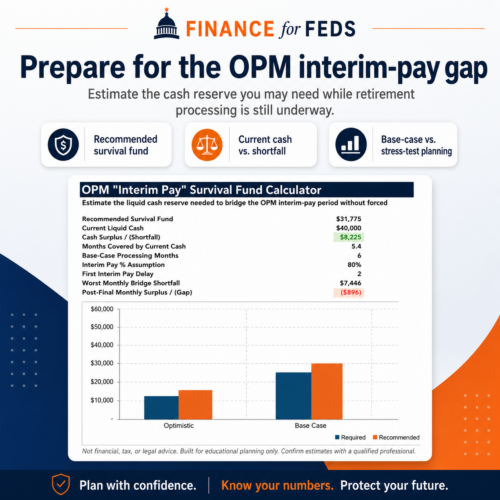
OPM Retirement Backlog: When you eventually retire, OPM can take 3 to 6 months to process your full FERS pension. During this interim period, you receive only partial payments (often 60–70% of your estimated annuity), requiring a cash cushion to bridge the gap.
-
Life Emergencies: Home repairs, medical deductibles, auto breakdowns, and family emergencies happen regardless of who signs your paycheck.
The 3-Tier Federal Emergency Reserve Framework
Instead of picking an arbitrary number of months based on gross salary, calculate your target using Essential Monthly Obligations (housing, utilities, food, debt minimums, healthcare, and essential insurance).
Tier 1: The Starter Fund ($1,000 – $2,500)
-
Who it’s for: Federal employees currently paying off high-interest debt (e.g., credit cards above 8–10% APR) or building momentum.
-
Purpose: Prevents you from adding new credit card debt when an unexpected car repair or medical bill pops up while you aggressively pay down debt.
Tier 2: Baseline Core Reserve (3 Months of Fixed Expenses)
-
Who it’s for: Dual-income households (where one or both spouses work), tenured Feds with low fixed overhead, or employees with minimal household debt.
-
Purpose: Easily absorbs typical 2- to 4-week government shutdowns, minor administrative pay delays, and standard household emergencies.
Tier 3: Extended Federal Buffer (6 to 12 Months of Fixed Expenses)
-
Who it’s for: Single-income households, employees approaching FERS retirement (to bridge OPM processing delays), Law Enforcement / Special Category Feds subject to mandatory retirement, or Feds with variable household income.
-
Purpose: Provides total financial independence during prolonged shutdown standoffs, major health events, or career transitions.
Real-World Case Studies
Example 1: Dual-Income Household (GS-12 + Private Sector Spouse)
-
Essential Monthly Expenses: $4,500
-
Household Structure: Dual-income, steady private-sector salary.
-
Target Tier: Tier 2 (3 Months of Fixed Expenses).
-
Emergency Fund Target: $4,500 × 3 = $13,500
Example 2: Single-Income Household Approaching Retirement (GS-14)
-
Essential Monthly Expenses: $6,000
-
Household Structure: Sole earner, planning FERS retirement in 18 months.
-
Target Tier: Tier 3 (6 Months of Fixed Expenses to cover OPM processing delays).
-
Emergency Fund Target: $6,000 × 6 = $36,000
Interactive Federal Emergency Fund Calculator
Federal Emergency Fund Calculator
Calculate your required cash reserve based on your essential fixed obligations and household risk profile.
*Calculations exclude discretionary spending, TSP balances, and non-liquid assets.
Where Should Federal Employees Keep Their Cash?
1. High-Yield Savings Accounts (HYSA) — Best Primary Option
-
Why: HYSAs at FDIC-insured online banks pay significantly higher interest than traditional brick-and-mortar savings accounts while maintaining complete liquidity.
-
Pro Tip: Keep your emergency fund at a separate financial institution from your daily checking account. Removing the funds from your main bank app reduces the temptation to spend your emergency buffer on discretionary purchases.
2. Short-Term U.S. Treasury Bills or Money Market Funds — Solid Secondary Option
-
Why: Backed by the full faith and credit of the U.S. government, state-tax-exempt, and liquid within 1–2 business days.
-
Best For: Holding Tier 3 extended reserves (months 4 through 12) where you want to maximize yield without taking stock market risk.
3. Why You Should NEVER Use Your TSP as an Emergency Fund
Some federal employees treat their Thrift Savings Plan (G Fund or TSP loans) as a backstop. This is an expensive mistake for three reasons:
-
TSP Loans Take Time: During a government shutdown or administrative disruption, TSP loan processing times can slow down dramatically.
-
Loss of Compounding Growth: Money borrowed from your TSP misses out on long-term market growth in the C, S, or I funds.
-
Early Withdrawal Penalties: Taking a hardship withdrawal incurs a 10% early withdrawal penalty (if under age 59½) plus ordinary income taxes.
How to Build Your Fund Without Missing the TSP Match
Building an emergency fund shouldn’t come at the cost of your retirement future. Follow this clear financial hierarchy:
-
Capture the 5% TSP Match First: Never stop contributing 5% to your TSP. The 5% FERS Agency Match is an immediate 100% return on your money.
-
Build a $1,000–$2,500 Starter Cash Cushion: Divert extra cash flow into your High-Yield Savings Account until you reach a basic safety net.
-
Pay Down High-Interest Debt: Clear credit cards or high-interest personal loans.
-
Fill Your Core Reserve (3–6 Months): Once high-interest debt is gone, build your target emergency fund in your separate HYSA.
-
Increase TSP & Investment Contributions: Once your target emergency fund is fully funded, redirect your extra monthly cash flow back toward maximizing your TSP, Roth IRA, or taxable brokerage account.
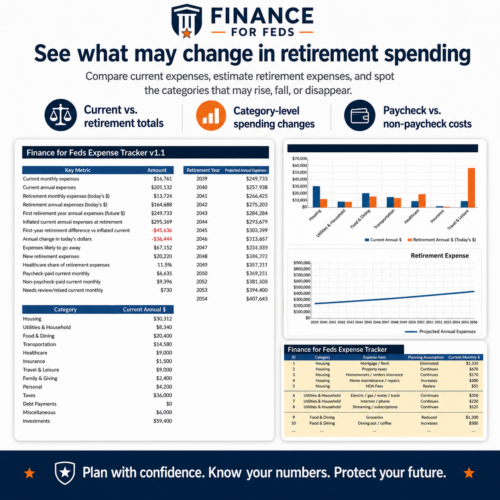
For step-by-step guidance on structuring your biweekly paycheck, explore our guide on How to Budget on a GS Salary (Without Overcomplicating It).
Related Tools
Share This Article
About the Author: Finance for Feds Editorial Team