
How Much Life Insurance Do Federal Employees Actually Need? (Simple Formula + Real Examples)
When you join the federal government, one of the easiest benefits choices to make is checking the box for FEGLI Basic and picking a few multiples of FEGLI Option B. Because coverage is automatic upon hire and costs appear small on an early-career paystub, many federal workers simply leave their life insurance on autopilot for decades.
However, relying on default coverage can lead to two expensive mistakes:
-
Being Severely Underinsured: Relying solely on default FEGLI without factoring in your family's actual debt, mortgage, and future income replacement needs.
-
Being Dramatically Overinsured (and Overpaying): Carrying 5x salary in FEGLI Option B well past age 50 when your pension, TSP, and decreased liabilities mean you no longer need that level of commercial coverage—costing you thousands in skyrocketing premiums.
Determining how much life insurance you actually need requires factoring in your unique federal benefits—including your FERS Survivor Annuity, TSP balance, Social Security Survivor Benefits, and FEGLI Basic.
Below is a simple federal-specific life insurance formula, real-world calculation examples across different career stages, and a guide on how to coordinate your private and federal coverage efficiently.
The Federal "L.I.M.E." Needs Formula
To calculate your true life insurance requirement, start with your family's total financial obligations and subtract the existing safety net already provided by your federal benefits:
Net Insurance Need = (Liabilities + Income Need + Major Goals) – Existing Federal Benefits
Step 1: Calculate Total Financial Needs
-
L – Liabilities: Total unpaid debt that must be settled immediately upon death (e.g., mortgage balance, car loans, personal debts, credit cards, plus ~$15,000 for funeral/final expenses).
-
I – Income Replacement: The dollar amount required to replace your paycheck so your surviving spouse or dependents can maintain their standard of living. Multiply the net income your family relies on annually by the number of years until your youngest child is independent or your spouse reaches retirement age.
-
M – Major Future Goals: Lump sums for specific future goals, such as college funds for children (e.g., $100,000 per child) or establishing an emergency fund for your surviving spouse.
Step 2: Inventory Your Existing Federal Safety Net
Unlike private-sector workers who start from zero, federal employees already have built-in death benefits:
-
FEGLI Basic: Equals your annual basic salary (rounded up to the next $1,000) plus $2,000. If you are under age 45, the Extra Benefit doubles this amount up to age 35, then scales down by 10% per year until age 45.
-
TSP Balance: 100% of your Traditional or Roth TSP balance is paid out directly to your designated beneficiaries as a lump sum.
-
FERS Basic Employee Death Benefit (BEDB): If you die as an active employee with at least 18 months of service, your surviving spouse receives a lump sum (~$40,000 indexed to inflation) plus 50% of your final salary.
-
FERS Survivor Annuity: If you die in service with at least 10 years of creditable service, your spouse may receive an ongoing monthly pension equal to 50% of your earned FERS pension annuity.
-
Social Security Survivor Benefits: Monthly benefit payments paid to your surviving spouse caring for children under age 16, or directly to unmarried children under age 18 (or 19 if in high school).
Real-World Federal Employee Case Studies
Case Study 1: The Early-Career Federal Employee
-
Profile: Sarah, Age 34 (GS-11, Step 3)
-
Salary: $80,000
-
Family Status: Married, 1 child (Age 2)
-
Financial Details: $320,000 mortgage; $15,000 car loan; $150,000 TSP balance; $50,000/year net income replacement needed for 18 years.
1. Total Financial Needs:
-
Mortgage + Debt + Final Expenses: $320,000 + $15,000 + $15,000 = $350,000
-
Income Replacement ($50,000/yr × 18 years): $900,000
-
College Fund Goal: $100,000
-
Total Needs: $1,350,000
2. Existing Federal Safety Net:
-
FEGLI Basic ($80,000 salary + $2,000 = $82,000; doubled under Age 35 Extra Benefit): $164,000
-
Current TSP Balance: $150,000
-
FERS BEDB Lump Sum + 50% Salary: ~$90,000
-
Total Federal Safety Net: $404,000 (Excluding monthly Social Security survivor benefits)
3. Net Life Insurance Need:
-
$1,350,000 – $404,000 = $946,000
Takeaway for Early-Career Feds: Sarah needs approximately $950,000 in total life insurance. FEGLI Basic alone ($164,000) is insufficient. However, rather than picking FEGLI Option B at 5x salary ($400,000) and still falling short, Sarah can lock in a 20-year private term policy for $1,000,000 at age 34 for a fraction of the cost.
Case Study 2: The Mid-Career Federal Employee
-
Profile: Mark, Age 52 (GS-14, Step 5)
-
Salary: $150,000
-
Family Status: Married, 2 teenagers (Ages 15 and 17)
-
Financial Details: $180,000 remaining on mortgage; $650,000 TSP balance; 24 years of FERS service.
1. Total Financial Needs:
-
Mortgage + Final Expenses: $180,000 + $15,000 = $195,000
-
Income Replacement ($60,000/yr × 10 years until spouse reaches retirement): $600,000
-
College Funds (Remaining tuition goals): $80,000
-
Total Needs: $875,000
2. Existing Federal Safety Net:
-
FEGLI Basic ($150,000 + $2,000): $152,000
-
Current TSP Balance: $650,000
-
FERS Earned Pension Value (24 yrs × 1.0% × $150,000 = $36,000/yr pension → Spouse receives 50% = $18,000/yr survivor pension): Lump-sum equivalence ~$200,000+
-
Total Federal Safety Net: $1,002,000+
3. Net Life Insurance Need:
-
$875,000 – $1,002,000 = $0 (Self-Insured)
Takeaway for Mid-Career Feds: Because Mark's TSP balance has grown to $650,000 and his earned FERS pension provides a substantial survivor annuity, Mark's built-in federal safety net exceeds his financial obligations. Mark can safely drop FEGLI Option B multiples entirely, avoiding the steep price jumps that hit FEGLI after age 50. Learn more about these rate spikes in our detailed guide on FEGLI Option B Costs After Age 50.
Interactive Life Insurance Needs Calculator
Use the calculator below to estimate your net life insurance gap after accounting for your federal salary, TSP savings, liabilities, and income replacement timeline.
FEGLI Option B vs. Private Term Life Insurance
If your calculation reveals a coverage gap, you must decide how to source that coverage. While FEGLI Option B is convenient because it requires no medical exam during initial onboarding, private level term insurance is often significantly cheaper for healthy employees.
| Feature | FEGLI Option B | Private 20-Year Level Term |
| Pricing Model | Increases every 5 years (Age-banded) | Locked fixed rate for 10, 20, or 30 years |
| Medical Underwriting | None (at hire / open season) | Yes (Medical exam or simplified underwriting) |
| Cost at Age 35 ($500k) | ~$21 / month | ~$18 – $25 / month |
| Cost at Age 55 ($500k) | ~$195 / month | ~$40 – $60 / month (If locked earlier) |
| Cost at Age 62 ($500k) | ~$433 / month | ~$40 – $60 / month (If locked earlier) |
| Portability | Rates spike in retirement; drops at 65 | Retain policy regardless of federal employment |
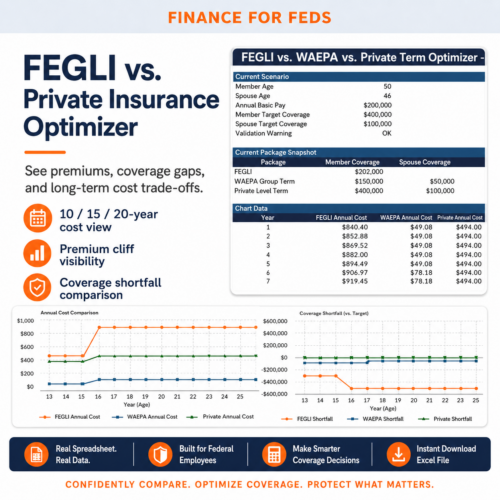
For a more detaled evaluation, use our FEGLI vs. Private Term Insurance Optimizer.
Strategic Action Plan for Federal Employees
Follow this step-by-step checklist to optimize your life insurance coverage:
-
Keep FEGLI Basic: FEGLI Basic is partially subsidized by the government (they pay 1/3 of the premium cost). It is inexpensive, reliable coverage that should generally be kept throughout your federal career.
-
Calculate Your True Need Annually: Re-run the L.I.M.E. formula every year when you review your open season benefits or update your GS Salary Take-Home Budget.
-
Replace FEGLI Option B While Healthy: If you are under age 50 and in average or good health, apply for a 15- or 20-year private level-term policy to cover your primary working years.
Golden Rule: Never cancel or reduce FEGLI Option B until your private replacement policy is fully underwritten, approved, and active.
-
Phase Down Coverage as Assets Grow: As your TSP balance increases and your mortgage balance decreases, incrementally drop FEGLI Option B multiples (e.g., from 5x down to 2x, then 0x). FEGLI allows you to reduce or cancel Option B coverage at any time.
-
Coordinate Survivor Elections at Retirement: When completing your FERS retirement application (Form SF-3107), align your FERS Survivor Annuity election with your private insurance holdings. Explore all retirement planning strategies in our Federal Retirement Planning Tool.
Related Tools
Share This Article
About the Author: Finance for Feds Editorial Team