

How the FERS Pension Is Calculated: Formula and Real Examples
Understanding how your Federal Employees Retirement System (FERS) Basic Annuity is calculated is the foundation of federal retirement planning. Unlike private-sector pensions that can feel opaque, the FERS pension formula is completely transparent and predictable.
Your monthly FERS annuity check is determined by three core variables:
-
Your High-3 Average Salary
-
Your Years of Creditable Service
-
Your FERS Pension Multiplier
By mastering how these three numbers interact, you can project your exact gross pension income, estimate the impact of retiring early versus staying until age 62, and optimize your retirement date.
The Core FERS Pension Formula
At its simplest, the FERS pension formula calculates your annual gross annuity as follows:
Annual FERS Pension = High-3 Average Salary × Years of Creditable Service × Pension Multiplier
Monthly FERS Pension = Annual FERS Pension ÷ 12
To understand how much income your pension will generate, let’s examine each of these three variables in detail.
Variable 1: High-3 Average Salary
Your High-3 Average Salary is the highest weighted average of your basic pay over any 36 consecutive months of credentialed federal service.
For most federal employees, their High-3 occurs during their final three years of service before retirement. However, it can occur during any 3-year consecutive window in your career if you previously held a higher GS grade or earned higher locality pay.
What Is Included in Your High-3?
-
Basic Pay (your GS step grade base pay)
-
Locality Pay Adjustments
-
Law Enforcement Availability Pay (LEAP) & Administratively Uncontrollable Overtime (AUO)
-
Special Salary Rates
What Is Excluded from Your High-3?
-
Standard Overtime Pay
-
Holiday Pay & Night Differential
-
Performance Bonuses & Cash Awards
-
Recruitment, Relocation, or Retention Incentives
-
Unused Annual Leave Payouts
Key Rule: Salary increases through step increases, COLAs, and promotions automatically raise your High-3 average as long as you remain at that pay rate for 36 consecutive months.
Variable 2: Years of Creditable Service
Your Years of Creditable Service represents the cumulative time you have worked under FERS, measured in full years and full months. Unused days that do not form a full month are dropped by OPM unless combined with unused sick leave.
Converting Unused Sick Leave into Service Time
FERS allows you to convert unused sick leave into creditable service time to boost your pension check:
-
2,087 hours of sick leave = 1 full year of creditable service time.
-
Sick leave cannot be used to make you eligible to retire earlier (e.g., reaching your Minimum Retirement Age). It is added to your total service calculation after you meet retirement eligibility requirements.
Military Service Buyback & Civilian Redeposits
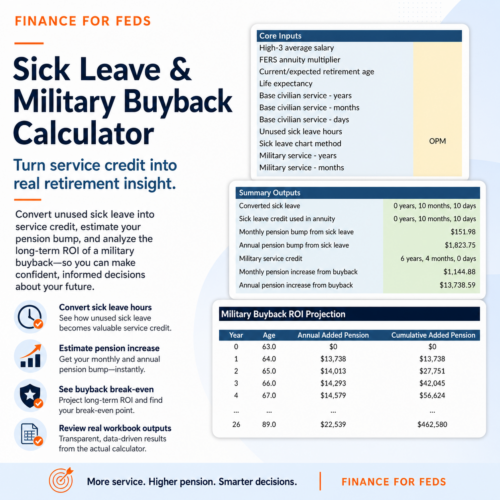
If you served on active military duty prior to your federal civilian service, completing a Military Service Buyback allows you to add those military years directly into your FERS creditable service time. Check your eligibility and calculation steps using our Federal Retirement Planning Tool.
Variable 3: The FERS Multiplier (1.0% vs. 1.1%)
The pension multiplier determines what percentage of your High-3 average salary you receive for each year of service. Under standard FERS rules, there are two primary multipliers:
1. The Standard Multiplier (1.0%)
-
Who Qualifies: Any federal employee retiring under regular FERS rules before age 62, OR retiring at age 62 or older with less than 20 years of service.
-
The Calculation: You receive 1.0% of your High-3 for each year of creditable service.
2. The Enhanced Multiplier (1.1% Bonus)
-
Who Qualifies: Federal employees who retire at age 62 or older with at least 20 years of creditable service.
-
The Calculation: You receive 1.1% of your High-3 for each year of creditable service.
The Age 62 Bonus Advantage: Delaying retirement from age 61 with 20 years of service to age 62 with 20 years of service raises your multiplier from 1.0% to 1.1%. That single year shift increases your lifetime pension payout by 10%!
Special Provisions Multiplier (1.7%)
Law Enforcement Officers (LEOs), Firefighters, Air Traffic Controllers, and Military Reserve Technicians receive an enhanced calculation:
-
1.7% per year for their first 20 years of special service
-
1.0% per year for any years of service exceeding 20 years
Real-World FERS Pension Calculation Examples
Example 1: Standard FERS Retirement (Age 60 with 25 Years)
-
Retirement Age: 60
-
Years of Service: 25 Years
-
High-3 Average Salary: $110,000
-
Applicable Multiplier: 1.0% (Under age 62)
Annual Pension Calculation:
$110,000 × 25 Years × 1.0% = $27,500 per year
Monthly Gross Pension:
$27,500 ÷ 12 = $2,291.67 per month
Example 2: Enhanced Multiplier Retirement (Age 62 with 25 Years)
-
Retirement Age: 62
-
Years of Service: 25 Years
-
High-3 Average Salary: $110,000
-
Applicable Multiplier: 1.1% (Age 62+ with 20+ years of service)
Annual Pension Calculation:
$110,000 × 25 Years × 1.1% = $30,250 per year
Monthly Gross Pension:
$30,250 ÷ 12 = $2,520.83 per month
The Difference: Waiting until age 62 generates an extra $229.16 per month ($2,750 per year) for life on the exact same salary and service record.
Interactive Model: FERS Pension Projection
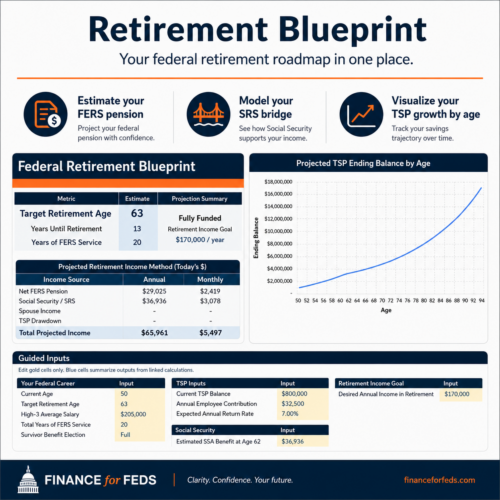
Use the interactive simulation below to project your annual FERS pension based on your High-3 salary and service timeline. Compare the difference between the standard 1.0% multiplier and the enhanced 1.1% multiplier at age 62+. For a more detailed model of your FERS pension and more, try our Finance for Feds Retirement Blueprint™
Reductions & Deductions: From Gross Pay to Net Check
Your calculated pension is your gross monthly annuity. Before that payment is deposited into your bank account, several automatic deductions and potential age penalties will apply:
-
Survivor Benefit Plan (SBP): Electing a full survivor benefit for your spouse reduces your gross annuity by 10% (providing a 50% benefit to your spouse). A half survivor benefit reduces your pension by 5% (providing a 25% benefit).
-
Federal & State Income Taxes: Your FERS pension is taxed as ordinary income. Learn how your annuity is taxed in our complete breakdown of Federal Retirement Taxes Under FERS.
-
FEHB Health Insurance Premiums: If you maintain Federal Employees Health Benefits (FEHB) in retirement, your monthly premiums are deducted directly from your pension check on an after-tax basis.
-
MRA+10 Early Retirement Penalty: If you retire at your Minimum Retirement Age (MRA) with between 10 and 29 years of service, your pension is permanently reduced by 5% for every year you are under age 62 unless you postpone your annuity start date.
Next Steps for Your Federal Retirement Plan
Your FERS pension is one leg of your federal “three-legged stool.” To build a complete retirement strategy:
-
Model your net take-home budget with our How to Budget on a GS Salary Guide.
-
Evaluate your TSP strategy in our guide to Traditional vs. Roth TSP in 2026.
-
Evaluate your life insurance costs as you approach retirement in our review of FEGLI Option B Costs After Age 50.
Explore all tools and resources at Finance for Feds!
Related Tools
Share This Article
About the Author: Finance for Feds Editorial Team