
How Does Unused Sick Leave Increase Your FERS Pension?
Federal employees tend to develop interesting relationships with sick leave.
Some use it as fast as they earn it. Others guard every single hour as if OPM plans to exchange it for beachfront property at retirement. By the final stretch of a career, it’s not unusual to hear someone proudly announce that they have 1,500 hours sitting in their leave bank.
Unused sick leave does have real financial value under FERS. But before you hoard every last hour, you need to understand what that value actually is—and what it isn’t.
The short version? Unused sick leave can increase the size of your monthly pension check, but it CANNOT be used to make you eligible to retire early.
Understanding that one distinction will save you from making a massive retirement planning mistake.
The Core Rule: Computation vs. Eligibility
This is the single most common myth in federal retirement.
Suppose you reach Minimum Retirement Age (MRA) with 29 years and 6 months of actual federal service. You also have 6 months’ worth of unused sick leave saved up.
Naturally, you might think:
29.5 years of work + 0.5 years of sick leave = 30 years. I hit MRA+30 and can retire today!
Unfortunately, OPM doesn’t work that way.
Unused sick leave only kicks in after you independently meet the age-and-service requirements for retirement. You cannot use sick leave to cross the finish line to reach 10, 20, or 30 years of service. You must hit your eligibility mark with actual civilian (and bought-back military) service first.
Once you cross that threshold, however, OPM adds your sick leave directly to your total service time to boost your monthly check.
The 2,087-Hour Rule: What Is Your Sick Leave Worth?
OPM does not pay you out in a cash lump sum for unused sick leave. Instead, they convert your hours into creditable service using an official 2,087-Hour Conversion Chart:
-
2,087 Hours = 1 Full Year of Service Credit
-
1,044 Hours = 6 Months of Service Credit
-
174 Hours = 1 Month of Service Credit
(Note: OPM converts smaller balances into months and days based on their official table. Any leftover days that don’t add up to a full 30-day month are dropped.)
What Does That Mean in Real Dollars?
Your basic FERS pension is calculated as:
High-3 Salary × Pension Multiplier (1% or 1.1%) × Creditable Service
Let’s look at how much sick leave actually adds to your lifetime annuity:
Scenario A: 6 Months of Sick Leave (1,044 Hours)
-
High-3 Salary: $100,000
-
Pension Multiplier: 1.0%
-
Added Pension: $100,000 × 1.0% × 0.5 years = +$500 / year (approx. +$41.67 / month)
Scenario B: 1 Full Year of Sick Leave (2,087 Hours)
-
High-3 Salary: $100,000
-
Pension Multiplier: 1.0%
-
Added Pension: $100,000 × 1.0% × 1.0 year = +$1,000 / year (approx. +$83.33 / month)
If you qualify for the 1.1% multiplier (retiring at age 62+ with 20+ years of service), that full year of sick leave adds +$1,100 / year for life.
That’s not yacht money. But it is guaranteed, inflation-adjusted, lifelong income created from time you didn’t take off.
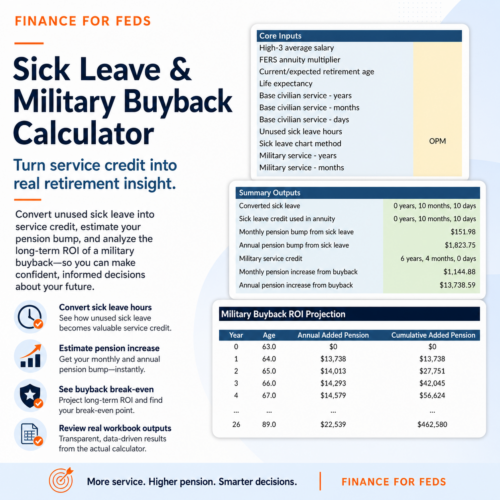
(Want to see your exact return? Use our Sick Leave & Military Buyback Calculator to plug in your leave balance and see your personal monthly pension bump.)
Sick Leave vs. Annual Leave: Don’t Confuse the Two
A frequent mistake feds make is treating annual leave and sick leave like they belong in the same bucket. They are handled completely differently when you separate:
-
Unused Annual Leave: Cash Asset. When you retire, OPM pays you out in a lump-sum cash check for all your unused annual leave at your final hourly pay rate.
-
Unused Sick Leave: Pension Asset. You get zero cash upfront. It is strictly converted into months of service to increase your monthly pension check.
Should You Stop Using Sick Leave Before You Retire?
No.
Unused sick leave is a great secondary retirement benefit, but it is not worth sacrificing your health or drag-racing to work with a fever.
Look at the math: 1,044 hours of sick leave (about six months of work) yields roughly $41.67 extra per month on a $100,000 High-3.
If you legitimately need knee surgery, physical therapy, or time off to care for a sick spouse, taking that time off during your working career is worth vastly more than a $40 monthly pension bump.
Don’t be the coworker who proudly shows up to the office sick just to protect $2 a day on a future pension check. Use your sick leave when you legitimately need it; preserve it when you don’t.
What to Do Before You Submit Your Papers
-
Check Your LES: Verify your sick leave balance on your Leave and Earnings Statement at least 12 months before retiring. Don’t assume 30 years of agency software updates preserved every hour flawlessly.
-
Combine Days with Civilian Service: OPM combines your actual service days with your converted sick leave days. If your total days add up to 30+, it rounds up to another full month of service!
-
Run the Full Calculation: Calculate your sick leave alongside any military buyback time to get an accurate view of your final High-3 payout.
The Bottom Line
Unused sick leave can add hundreds—or even thousands—of dollars a year to your FERS pension.
Know the rules: 2,087 hours equals one year of credit, it increases your check rather than your retirement eligibility, and it pays out over your lifetime.
Having a 1,500-hour sick leave balance is an impressive stat. Knowing exactly how much those 1,500 hours will add to your monthly check is smart retirement planning.
Related Tools
Share This Article
About the Author: Finance for Feds Editorial Team