
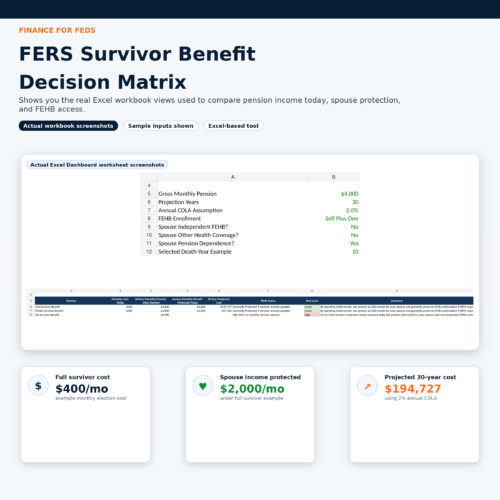
Understand the true cost and value of protecting your spouse in retirement.
At retirement, federal employees must make a critical survivor benefit decision that can affect both household income and a spouse’s ability to maintain FEHB coverage. This decision matrix compares the maximum survivor benefit, partial survivor benefit, and no survivor benefit options in plain dollars. Users can see the monthly pension reduction, projected long-term cost, survivor income protection, and FEHB implications of each election. Rather than treating the survivor benefit as just another retirement form, this tool helps users understand the real trade-off between keeping more pension income today and protecting a spouse’s financial security tomorrow.-
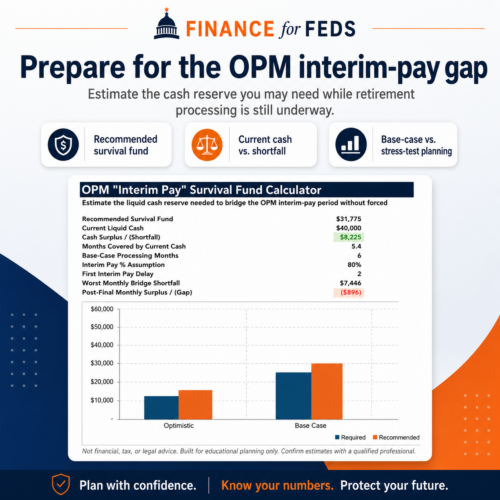
Know how much cash you need before your federal retirement checks are finalized.
Retiring from federal service does not always mean your full pension starts right away. During OPM processing, retirees may receive only partial interim payments for several months while their final annuity is calculated. This calculator helps users estimate their potential income gap during that transition period by comparing projected interim pay against real retirement expenses. Users can test different OPM processing delays, interim pay percentages, and monthly spending levels to determine how much cash they should keep available before retirement. It is designed to help federal employees avoid relying on credit cards, emergency withdrawals, or forced TSP distributions during the first months of retirement. -
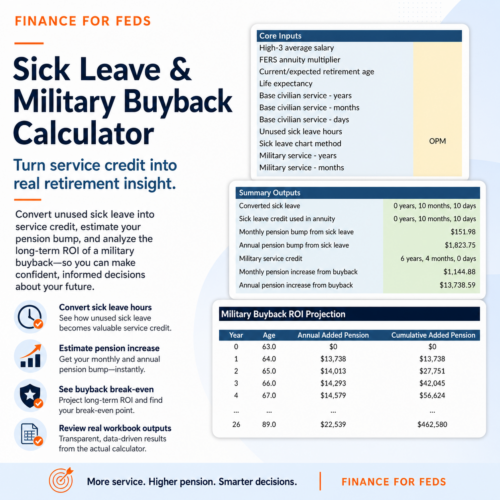
Turn unused sick leave and military service into clear retirement value.
Unused sick leave and military service credit can have a meaningful impact on a federal employee’s lifetime pension—but the rules are often confusing. This calculator converts sick leave hours into additional FERS service credit and estimates the resulting increase in monthly and lifetime pension income. It also helps users evaluate the value of military service buyback by comparing the deposit cost against the projected increase in their FERS annuity. The result is a clear break-even analysis that helps federal employees understand whether buying back military time may be one of the best retirement investments they can make. -
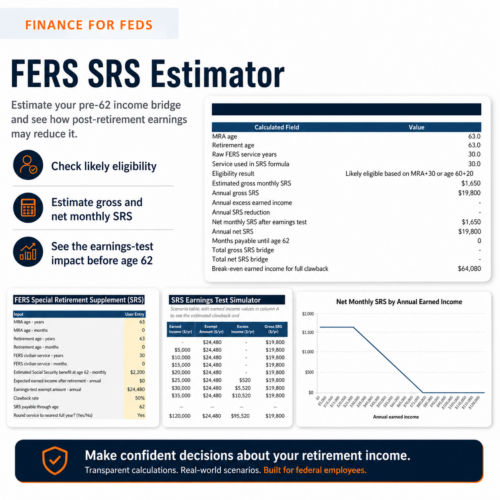
Estimate your federal retirement bridge income before age 62.
The FERS Special Retirement Supplement can be one of the most valuable—but most misunderstood—benefits available to eligible federal retirees. This estimator helps users calculate their potential monthly supplement based on their estimated age-62 Social Security benefit and years of FERS civilian service. It also includes an earnings test simulator so users can see how post-retirement wages may reduce or eliminate the supplement before Social Security begins. For federal employees considering retirement before age 62, this tool helps clarify how much bridge income they may receive and how outside work could affect that benefit. -
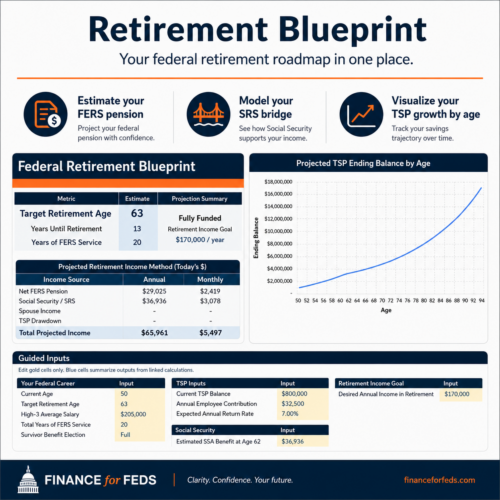
Plan your retirement with confidence—not guesswork.
The Finance for Feds Retirement Blueprint is a comprehensive retirement planning workbook built specifically for federal employees. Model your FERS pension, TSP balances, Social Security, investment accounts, retirement spending, healthcare costs, and long-term withdrawal strategy—all in one place. Interactive dashboards and easy-to-understand charts show whether you're on track, how long your money may last, and how changes today could affect your retirement decades from now. Whether retirement is five years away or twenty-five, this tool gives you a personalized roadmap toward financial independence.