Navigating Your Federal Career: Major Benefit & Leave Milestones
 When you join the civil service, your compensation goes far beyond your base salary. The federal benefits package—spanning the Federal Employees Retirement System (FERS), the Thrift Savings Plan (TSP), leave accrual, and insurance protections—is structured around specific career milestones.
Whether you are in your first week or approaching retirement, tracking these key timeframes ensures you do not leave money, leave, or protection on the table.
Phase 1: Onboarding & First 90 Days
The actions you take before and immediately after your official appointment lay the foundation for your wealth accumulation and leave balances.
Pre-Appointment: Creditable Non-Federal Service (5 U.S.C. 6303)
-
What Happens: Under OPM rules, agencies may grant creditable service for prior non-federal or uniformed service experience to determine your Leave Service Computation Date (SCD-Leave).
-
The Catch: This must be requested, approved, and documented prior to your official entrance on duty (EOD). It cannot be applied retroactively once you are appointed.
Day 1: TSP Match & Benefits Elections
-
TSP Matching (5 CFR § 1600): New hires automatically receive the 1% Agency Automatic Contribution. To capture the full 5% government match, you must contribute at least 5% of your basic pay from your very first paycheck.
-
FEHB & FEGLI: You have 60 days from your EOD to enroll in the Federal Employees Health Benefits (FEHB) program and Federal Employees’ Group Life Insurance (FEGLI) without health underwriting.
First Pay Period: Sick Leave Accrual Begins
-
4 Hours Per Pay Period: Full-time employees accrue 4 hours of sick leave every biweekly pay period (104 hours per year) with no ceiling on accumulation. Unused sick leave counts toward your total service credit when calculating your FERS pension at retirement.
Phase 2: Early Career (18 Months to 3 Years)
Your first few years locked in key safety-net features and vestment rights.
Phase 3: Mid-Career (5 to 15 Years)
During this phase, you secure your pension rights and maximize your leave generation.
5 Years: Pension Vesting & Military Service Deposits
-
FERS Vesting: Five years of creditable civilian service vests you for a FERS Deferred Annuity. Even if you leave federal service at year 5, you are entitled to a pension payable at age 62 (provided you do not withdraw your FERS contributions).
-
Military Service Deposit: If you have active-duty military service, completing a military deposit within your first 3 years avoids interest charges. By 5 years, you can convert that military time directly into civilian service credit for your pension computation.
10 Years: Loan Forgiveness & Survivor Annuities
-
FERS Spouse Survivor Annuity: Upon hitting 10 years of service, an in-service death grants a surviving spouse a lifetime monthly annuity equal to 50% of your accrued FERS benefit.
-
Public Service Loan Forgiveness (PSLF): After 120 qualifying, consecutive monthly payments under a qualifying repayment plan while working full-time for the federal government, remaining federal student loan balances may be forgiven tax-free.
15 Years: The Top Annual Leave Tier
-
8 Hours Per Pay Period: You reach the highest leave tier, accruing 8 hours of annual leave per pay period (208 hours / 26 days per year).
-
Annual Leave Ceiling: Keep in mind that for most domestic feds, the maximum annual leave carryover is 240 hours (30 days) into the next leave year (“use-it-or-lose-it”).
Phase 4: Late Career & Retirement Eligibility
Retirement under FERS depends on a combination of age and length of service. Your Minimum Retirement Age (MRA) is between 55 and 57, depending on your birth year.
Eligible for an immediate annuity at Minimum Retirement Age (MRA) with 10–29 years of service. Subject to a 5% pension reduction per year for every year under age 62 (unless deferred).
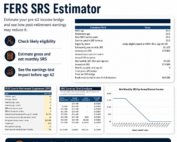
Full unreduced pension benefit. Includes eligibility for the FERS Annuity Supplement (bridging income equal to estimated Social Security) until age 62.
Full unreduced annuity with 20 or more years of service at age 60. Includes the FERS Annuity Supplement until turning age 62.
Full unreduced pension with at least 5 years of creditable civilian service. Note: Does not qualify for the FERS Annuity Supplement as you are already Social Security eligible.
Your pension multiplier increases from 1.0% to 1.1% for all years of service. For example, 20 years yields a 22% High-3 pension instead of 20%—a 10% lifetime bump.
To carry your FEHB health insurance and FEGLI life insurance into retirement, OPM requires continuous coverage in the program for the 5 consecutive years of service immediately preceding your retirement date (or for all service since your first opportunity to enroll). Lapsing coverage near retirement forfeits lifetime retiree health benefits.